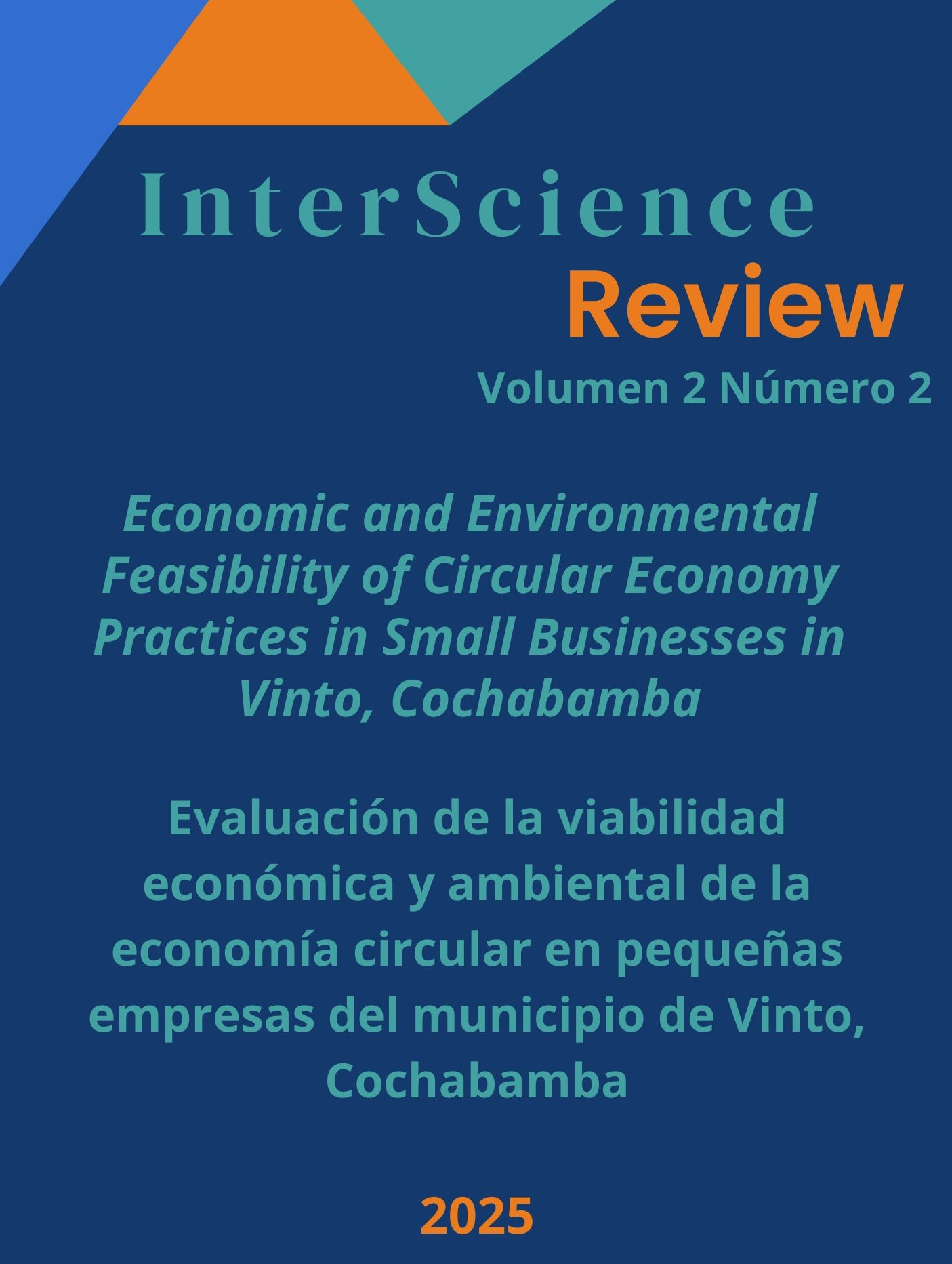
Economic and Environmental Feasibility of Circular Economy Practices in Small Businesses in Vinto, Cochabamba
Evaluación de la viabilidad económica y ambiental de la economía circular en pequeñas empresas del municipio de Vinto, Cochabamba
DOI:
https://doi.org/10.69128/isr.v2i3.23Palabras clave:
economía circular, sostenibilidad empresarialResumen
This research analyzes the impact and economic feasibility of implementing circular economy practices in small businesses in the municipality of Vinto, Cochabamba. The study employs a quantitative descriptive approach through the application of a semi-structured survey to 138 local enterprises. Results show that 68.12% of businesses use disposable materials in their operations, while 75.36% expressed willingness to replace them with biodegradable and sustainable alternatives. Likewise, 89.13% indicated interest in receiving free consultancy to strengthen their business capacities. It was found that 30% of the companies already apply circular economy practices, achieving both economic and environmental benefits, such as reduced operational costs and optimized resource use. These findings demonstrate that adopting circular practices can enhance the profitability and sustainability of local businesses, contributing to the reduction of environmental impacts. However, barriers such as the lack of technical knowledge and institutional support persist, highlighting the need for public policies and training programs to facilitate the transition toward sustainable production models. In conclusion, the circular economy represents a viable and promising strategy for the sustainable development of small enterprises in Vinto-Cochabamba.
Descargas
Citas
BBVA. (2023). Banco Bilbao Vizcaya Argentaria S.A. BBVA. https://www.bbva.com/es/sostenibilidad/que-es-la-economia-circular/
Buren, N. v. (2016). Towards a circular economy: The role of logistics industries and Dutch governments. Sustainability, 8(7), 647. https://doi.org/10.3390/su8070647
Campolina, J. S. (2017). A study on the environmental aspects of WEEE plastics recycling in a Brazilian company. International Journal of Life Cycle Assessment Volume.
Díaz, R. M. (2020). Economía circular: desafíos para una visión estratégica de las empresas exportadoras. Universidad Técnica de Machala, Ecuador.
Govindan, K., & Hasanagic, M. (2018). A systematic review on drivers, barriers, and practices towards circular economy: A supply chain perspective. International Journal of Production Research, 56(1-2), 278–311. https://doi.org/10.1080/00207543.2017.1402141
Kumar, V., Sezersan, I., Garza-Reyes, J. A., Gonzalez, E. D. R. S., & AL-Shboul, M. A. (2019). Circular economy in the manufacturing sector: benefits, opportunities and barriers. Management Decision, 57(4), 1067–1086. https://doi.org/10.1108/MD-09-2018-1070
Lavagnini Barboza, A. C. (2021). Los valores organizacionales como habilitadores de la economía circular y la sostenibilidad. Revista de Administração de Empresas, 62(2). https://doi.org/10.1590/S0034-759020220509
Leonice Troiani, S., & Soares, S. (2020). Moda sostenible: un análisis desde la perspectiva de la enseñanza de buenas prácticas de sostenibilidad y economía circular. Revista Brasileira de Pesquisa em Educação em Ciências, 20, e200214. https://doi.org/10.1590/1679-395120200214
Pagani, R. K., Kovaleski, J. L., & Resende, L. M. (2015). Methodi ordinatio: A proposed methodology to select and classify relevant scientific papers encompassing the impact factor, the number of citations, and the year of publication. Scientometrics, 105(2), 755–780.
Pauliuk, S. (2017). Critical appraisal of the circular economy standard. Resources, Conservation and Recycling, 126, 9-13. https://doi.org/10.1016/j.resconrec.2017.10.019
Sauvé, S., Bernard, S., & Sloan, P. (2016). Environmental sciences, sustainable development and circular economy: Alternative concepts for trans-disciplinary research. Environmental Development, 17, 48–56.
Tashakkori, A., & Teddlie, C. (2007). The new era of mixed methods. Journal of Mixed Methods Research, 1(1), 3–7. https://doi.org/10.1177/2345678906293042
Venanzi, D., Silva, O. R., & Seifert, A. (2021). Economía circular: estudio de caso en la empresa ABC. Revista Colombiana de Materiales, 13(25), 108–117. https://www.redalyc.org/journal/4776/477669106007/
Descargas
Publicado
Cómo citar
Número
Sección
Licencia
Derechos de autor 2025 Lilian Aguilera; Rodrigo Encinas

Esta obra está bajo una licencia internacional Creative Commons Atribución-NoComercial 4.0.