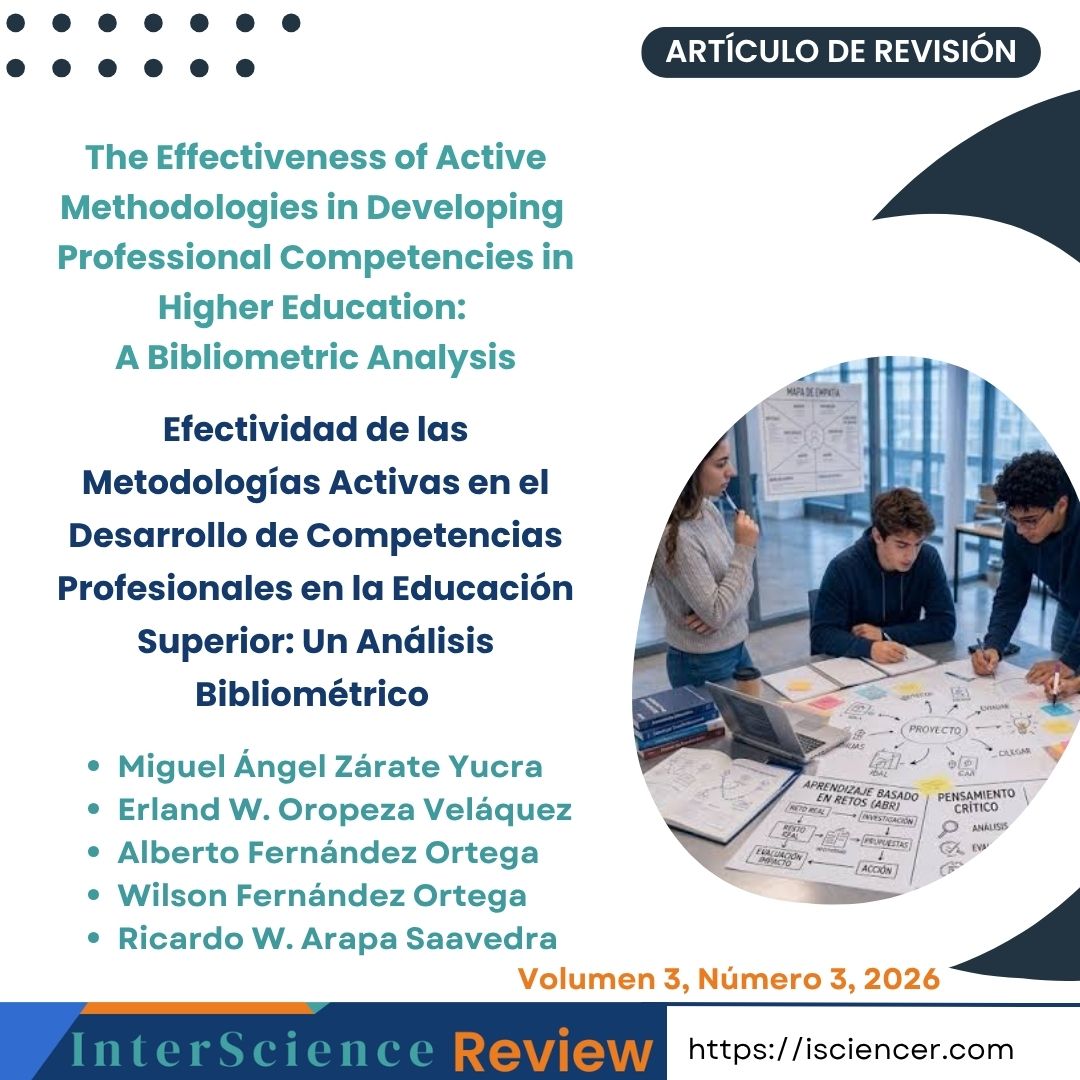
The Effectiveness of Active Methodologies in Developing Professional Competencies in Higher Education: A Bibliometric Analysis
Efectividad de las Metodologías Activas en el Desarrollo de Competencias Profesionales en la Educación Superior: Un Análisis Bibliométrico
DOI:
https://doi.org/10.69128/isr.v3i3.46Palabras clave:
Higher Education, Active Learning, Problem-Based Learning, TEMAC Approach, ScientometricsResumen
This study examines the conceptual evolution, intellectual framework, and relational scope of scientific literature dedicated to active learning methodologies and their impact on competency development in higher education. Guided by the integrated TEMAC framework, a knowledge audit was conducted on a refined corpus of 1,187 scientific articles indexed in the Scopus database between 2021 and 2026. The processing and mapping of bibliometric networks were managed using VOSviewer (versión 1.6.20) software. Semantic findings reveal that the current research agenda has moved past emergency technological adaptation to focus on Problem-Based Learning (PBL) and essential human dimensions such as student engagement, self-concept, and practical clinical skills. At the epistemological level, author co-citation analysis identifies a mature conceptual core grounded in theories of social constructivism and cognitive self-regulation (Bandura, Vygotsky, Zimmerman, and Kolb). Furthermore, bibliographic coupling and chronological analysis reflect an active and cohesive research front moving toward sustainable curricular co-design and the integration of disruptive digital dynamics.
Descargas
Citas
Akçayır, G., & Akçayır, M. (2018). The flipped classroom: A review of its advantages and challenges. Computers & Education, 126, 334–345. https://doi.org/10.1016/J.COMPEDU.2018.07.021
Aslan, A. (2021). Problem- based learning in live online classes: Learning achievement, problem-solving skill, communication skill, and interaction. Computers and Education, 171. https://doi.org/10.1016/j.compedu.2021.104237
Aston, K. J. (2024). ‘Why is this hard, to have critical thinking?’ Exploring the factors affecting critical thinking with international higher education students. Active Learning in Higher Education, 25(3), 537–550. https://doi.org/10.1177/14697874231168341
Aziz, A., & Hossain, M. T. (2024). Digital Access, Resources, and Literacy: Mapping the Digital Divide and ICT Learning Challenges among Undergraduate Students in Bangladesh. Asiascape: Digital Asia, 11(3), 246–267. https://doi.org/10.1163/22142312-bja10064
Bandura, A. (1986). Social foundations of thought and action : a social cognitive theory [Book]. Prentice-Hall.
Bezanilla, M. J., Markuerkiaga, L., & Paños-Castro, J. (2021). An analysis of the entrepreneurial university in the faculties of education in spain: Self-perception among deans. Sustainability (Switzerland), 13(21). https://doi.org/10.3390/su132111768
Bhagwat, R., & Kulkarni, A. (2025). Integrating project-based learning for enhancing higher education within an outcome-based education framework. International Journal of Evaluation and Research in Education, 14(5), 4099–4108. https://doi.org/10.11591/ijere.v14i5.31957
Biggs, J. (1979). Individual Differences in Study Processes and the Quality of Learning Outcomes. In Source: Higher Education (Vol. 8, Number 4). http://www.jstor.orgURL:http://www.jstor.org/stable/3446151Accessed:23/06/200822:50
Brooks, J. V, & Hughes, D. (2024). Flipping the expert: faculty educator sensemaking during transition to an active learning-based curriculum. BMC Medical Education, 24(1). https://doi.org/10.1186/s12909-024-05039-4
Brownell, S. E., & D, T. K. (2012). Barriers to Faculty Pedagogical Change: Lack of Training, Time, Incentives, and…Tensions with Professional Identity? CBE—Life Sciences Education, 11(4), 339–346. https://doi.org/10.1187/cbe.12-09-0163
Chang, C.-Y., Setiani, I., Darmawansah, D., & Yang, J. C. (2024). Effects of game-based learning integrated with the self-regulated learning strategy on nursing students’ entrustable professional activities: A quasi-experimental study. Nurse Education Today, 139. https://doi.org/10.1016/j.nedt.2024.106213
Chang, Y.-H., Yan, Y.-C., & Lu, Y.-T. (2022). Effects of Combining Different Collaborative Learning Strategies with Problem-Based Learning in a Flipped Classroom on Program Language Learning. Sustainability (Switzerland), 14(9). https://doi.org/10.3390/su14095282
Chen, Y., Ma, L., Pirzada, P., & Chai, K. K. (2025). Evaluating a Guided Personalised Learning Model in Undergraduate Engineering Education: A Data-Driven Approach to Student-Centred Pedagogy. Education Sciences, 15(7). https://doi.org/10.3390/educsci15070925
Clarke, V., & Braun, V. (2006). Using thematic analysis in psychology. Qualitative Research in Psychology, 3(2), 77–101. https://doi.org/10.1191/1478088706qp063oa
Cortázar, C., Nussbaum, M., Harcha, J., Alvares, D., López, F., Goñi, J., & Cabezas, V. (2021). Promoting critical thinking in an online, project-based course. Computers in Human Behavior, 119. https://doi.org/10.1016/j.chb.2021.106705
De Santo, A., Farah, J. C., Martinez, M. L., Moro, A., Bergram, K., Purohit, A. K., Felber, P., Gillet, D., & Holzer, A. (2022). Promoting Computational Thinking Skills in Non-Computer-Science Students: Gamifying Computational Notebooks to Increase Student Engagement. IEEE Transactions on Learning Technologies, 15(3), 392–405. https://doi.org/10.1109/TLT.2022.3180588
Díaz, M. J. S., Antequera, J. G., & Pizarro, M. C. (2021). Flipped classroom in the context of higher education: Learning, satisfaction and interaction. Education Sciences, 11(8). https://doi.org/10.3390/educsci11080416
Du, X., Ba Hattab, R. A. S., Daud, A., Philip, N. I., Anweigi, L., Matoug-Elwerfelli, M., & Al Khabuli, J. O. S. (2023). Development of professional identity among dental students – A qualitative study. Journal of Dental Education, 87(1), 93–100. https://doi.org/10.1002/jdd.13092
Descargas
Publicado
Cómo citar
Número
Sección
Licencia
Derechos de autor 2026 Miguel Ángel Zárate Yucra, Erland Williams Oropeza Velasquez , Alberto Fernández Ortega, Wilson Fernández Ortega, Ricardo Arapa Saavedra

Esta obra está bajo una licencia internacional Creative Commons Atribución-NoComercial 4.0.